
CNC Chip Breaking: Why Chips Should Break Short and What to Adjust First
Control chips through feed, depth of cut, chipbreaker, flute geometry, coolant, and material behavior.
Quick Answer
Quick answer: CNC chip breaking is not only about chipbreaker shape; feed, DOC, coolant, and material all matter Long chips often mean chip load is outside the cutting edge's working range
Key Takeaways
CNC chip breaking is not only about chipbreaker shape; feed, DOC, coolant, and material all matter
Long chips often mean chip load is outside the cutting edge's working range
Gummy steel and stainless need different chip control than cast iron and aluminum
Shop-Floor Decision Table
| Symptom | Likely Cause | First Action |
|---|---|---|
| Long chips wrap around the part or holder | Feed/DOC is outside the chipbreaker's working range | Increase feed or select a chipbreaker for the material |
| Chips are short but the edge chips | Chip load or impact is too high | Reduce DOC/feed one at a time and check rigidity |
| Aluminum chips weld to the edge | Geometry, coolant, or air blast cannot evacuate chips | Use wider chip space and improve air or coolant flow |
Shop-Floor Check
Identify whether chips are long, short, hot, or welding to the edge
Compare feed and DOC with the chipbreaker's working range
Select a PILOT insert chipbreaker for the material and roughing/finishing level
Use coolant or air blast to help move chips away from the cut
Record chip photos before and after adjustment for the next shift
Common Mistakes
- • Using one coolant setup for every material without adjusting concentration
- • Adding water to save cost until concentration falls too low
- • Changing insert grade before checking nozzles, pressure, filters, and chip evacuation
- • Changing several speed/feed values at once so the cause is hidden
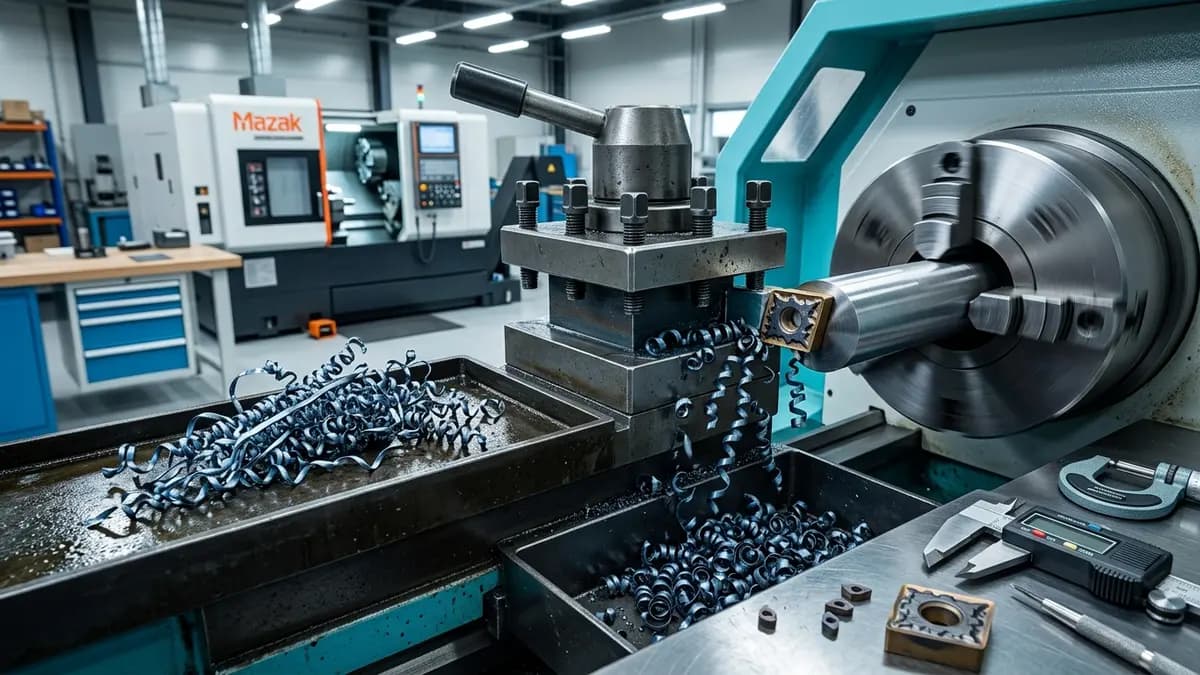
Long chips are not only messy. They wrap holders, scratch parts, block coolant, and force operators to stop the machine. Good CNC chip breaking makes chips short enough to evacuate without overloading the edge.
Why Coolant, Heat, and Chip Control Are Connected
Most cutting heat should leave with the chip. If chips are too thin, too long, or trapped in the cut, heat returns to the edge and the part. Coolant is not just about wetting the workpiece; it removes heat, reduces built-up edge, and helps push chips away. In turning, match PILOT inserts, grade, and chipbreaker with feed and DOC, not material alone.
How to Choose and Apply It on the Shop Floor
- CNC chip breaking is not only about chipbreaker shape; feed, DOC, coolant, and material all matter
- Long chips often mean chip load is outside the cutting edge's working range
- Gummy steel and stainless need different chip control than cast iron and aluminum
For general steel, start with coolant that balances cooling and lubricity. Stainless needs stable coolant to reduce work hardening and edge heat. Cast iron may run dry or with air blast in many jobs, but graphite dust and filtration must be controlled. Aluminum needs chip evacuation, built-up edge control, and sharp geometry. For turning inserts, start from material groups such as P, M, K, or N, then choose the PILOT chipbreaker from the actual chip behavior.
Cautions and When to Ask CAGO to Review
Do not copy coolant or speed/feed settings from another job without matching material, hardness, depth, and machine condition. If the case is unclear, send CAGO the material, current tool, chip photos, wear photos, operation, coolant type, concentration, and current tool life for a case review.
FAQ
What should CNC coolant selection start from?
Start from material and operation: steel, stainless, cast iron, aluminum, milling, turning, or deep drilling. Then review coolant type, concentration, and pressure.
If a tool overheats, should I change the insert first?
Not immediately. First check whether coolant reaches the cutting edge, whether concentration is correct, and whether chips leave the cutting zone.
How do PILOT inserts help chip breaking?
PILOT inserts offer grades and chipbreakers for different materials such as steel, stainless, and aluminum, but they still need the right feed, DOC, and coolant.